

How to store cashmere through a London summer
The damage to cashmere is rarely done while you are wearing it. It happens in the months it sits folded in a drawer. Here is how we prepare knitwear for the warm season so it comes out in September as it went in.

Every September the same garments arrive at our counters: a favourite jumper with a scatter of small holes across the front, a cardigan that smells faintly of the drawer it lived in, a scarf that has lost its softness. None of it happened in winter. It happened in the four or five months nobody was looking. Storing cashmere well is not complicated, but it does have an order to it, and the order matters.
01Why summer is the risk
Cashmere is a fine animal fibre, and the things that damage it are patient. Clothes moth larvae feed on keratin, the protein that wool and cashmere are made of, and they are drawn most to fibres that carry traces of skin, perspiration or food. Warmth speeds up their life cycle. A London flat in July, with the windows shut while you are away, gives them exactly the still, warm, undisturbed conditions they prefer.
Add to that the ordinary effects of time. A garment stored with a faint mark will come out with a set stain, because the mark oxidises slowly in the dark. A jumper hung on a hanger for five months will have grown at the shoulders. Neither is dramatic on its own. Both are avoidable.
02Clean before you store
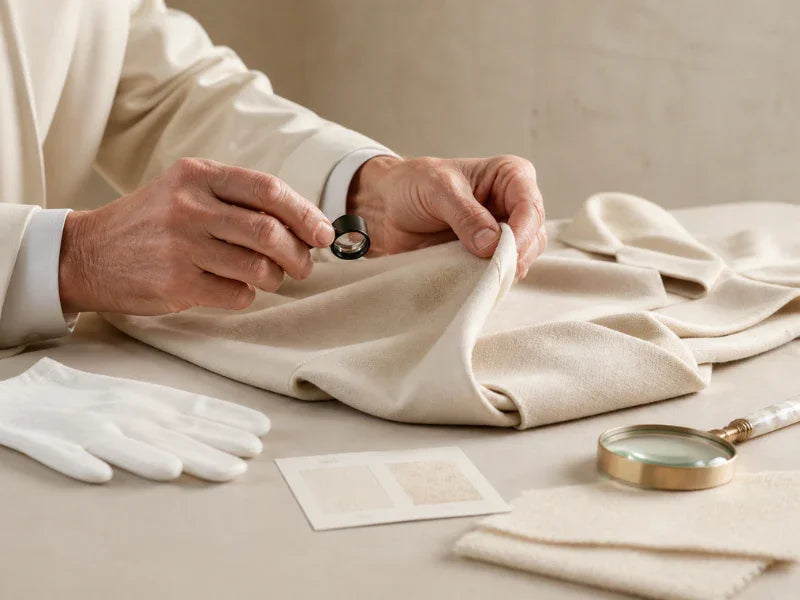
This is the single step that does most of the work, and it is the one most often skipped because the garment looks fine. “Looks fine” is not the standard. A jumper worn twice over a dinner carries enough on it to interest a moth and to set a mark over a warm season.
Cashmere does not want heat and it does not want harsh solvents. At Blanc, knitwear is cleaned by one of two methods depending on the fibre and the finish: liquid CO₂ dry cleaning, which works without heat and is gentle on fine animal fibres, or professional wet cleaning with biodegradable detergents. We have never used PERC, the conventional dry cleaning solvent, and we do not intend to. After cleaning, each piece is reshaped and finished without a hard press, so the loft of the fibre is kept.
If you would rather wash at home, use cool water, a detergent made for wool, no wringing and no tumble dryer. Press the water out between two towels and dry flat, away from sun. Home washing is perfectly good for a lightly worn piece; it is less reliable for marks that have already set, and it will not lift what a moth is drawn to as thoroughly as a professional clean.
03Fold, never hang
A hanger is the wrong shape for a knitted garment. The weight of the body pulls down from two points at the shoulders, and over a summer that pull becomes a permanent dimple in the knit and a stretched neckline. Cashmere should be folded, and folded loosely rather than pressed into a hard crease.
- Lay the piece face down, fold the sleeves across the back, then fold the body once from the hem. Two folds at most.
- Do not stack heavily. Four or five pieces in a pile is about right. The bottom of a tall stack will be flattened by September.
- Acid free tissue between layers if the pieces are pale or if you are storing dark and light together. It stops colour transfer and stops the knits catching on each other.
- Never store in the dry cleaning bag. The plastic traps whatever moisture is in the air and stops the fibre breathing. Take it off the day the garment comes home.
04Where to keep it
The right place is cool, dry, dark and closed. In most London homes that means a drawer or a wardrobe shelf in a bedroom, not a loft, a cellar or the cupboard above the boiler. Lofts swing between hot and cold and tend to be dusty. Cellars are damp. Both are where we see the worst of the September arrivals coming from.
Within the drawer, a breathable cotton storage bag with a zip is the best container we know of. It keeps dust off, it lets the fibre breathe, and a moth cannot get into a bag that is properly closed. Plastic boxes are a reasonable second choice provided the garments went in clean and completely dry; a box that is sealed with damp inside it is worse than no box at all.
The most sustainable garment is the one already in your wardrobe, cared for properly and kept in use.
Craft over speed · Care over convenience
05On moths, plainly
We are often asked whether cedar blocks work. They help, a little, while they are fresh; the scent fades within a few months and needs sanding back or replacing. Lavender behaves the same way. Neither should be relied on as the plan. They are a pleasant addition to a plan that starts with cleaning.
If you do find holes in September, the piece is usually not lost. Small holes in a fine knit can be closed and larger areas rebuilt by a skilled repairer, and it is worth doing before the hole runs. Our alterations and repairs team will tell you honestly whether a garment is worth saving. Wash or clean everything that shared the drawer with it, whether or not it shows damage, and empty and wipe the drawer before anything goes back.
06Bringing it out in September
When the weather turns, take everything out, unfold it and let it breathe for a day on a flat surface before wearing. Any faint drawer smell will lift on its own. A knit that has developed a few surface pills over the summer can be tidied with a cashmere comb, used lightly and always in one direction.
Look each piece over in good light. Check the underarms, the collar and the front, where a moth would have started. If it is clean and whole, it is ready. If it is not, it is far easier to put right now than after a season of wear on top.
That is the whole method: clean, fold, close, cool, and check. Cashmere that is treated this way for a few summers will still be the softest thing in the wardrobe long after the fast fashion around it has gone.
Send it to us. It comes back clean, reshaped and ready to wear.
Enter your postcode to book a collection. Standard turnaround is 48 to 72 hours, and collection and delivery are free on orders over £30.
Four London studios: Marylebone, Notting Hill, Chelsea and South Kensington.More from the atelier.

The handbag care routine that keeps leather for decades.
A good leather handbag is built to outlast the person who bought it, provided it is looked after in a few simple,…
Read the article →
Fine bed linen: laundering at home versus the atelier.
Good bed linen is one of the few household textiles that genuinely improves with age, provided it is laundered in a way…
Read the article →
How to read a care label (and when to ignore it)
A care label is a manufacturer covering its own risk, not a precise instruction written for your specific garment. Most of the…
Read the article →Have a question about a garment?
Ask us. Leave your email and a specialist will reply.
Or call 020 8004 2630